Caring for Your Child With Torticollis

Babies with torticollis usually get better in a few months with treatments that can be done at home.
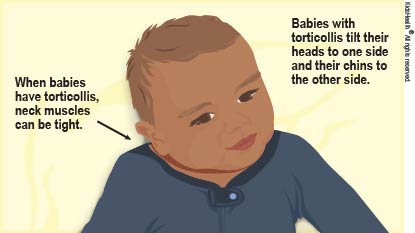

Babies with torticollis (tor-ti-KOLL-iss) keep their head tilted to one side and their chin tilted to the other side. Torticollis is sometimes hard to see when babies are born. It becomes easier to see as babies grow and move more. When babies are born with torticollis, or it is noticed in the first few weeks after birth, the condition is called congenital torticollis.
It is not always known what causes torticollis. For many babies, it may start when the neck muscles get pulled or cramped in the womb or during birth. Over time, the muscles grow tight. This makes it hard for babies to move the head and neck normally.
Babies with torticollis may have a small lump or bump on the neck where the muscle is tight. They may also have flattening of their head from lying on one side of the head so often. Most babies do not feel any pain from torticollis.
During your baby's visit, the health care professional asked you questions and checked your baby's neck carefully. Special tests usually are not needed to diagnose torticollis.
Treatment for torticollis includes gentle stretching and simple changes in sleeping, feeding, and playing positions.
With treatment, most babies get better in a few months. To help with treatment, the health care professional may recommend that you take your baby to a physical therapist. If the torticollis does not go away, a specialist may recommend a soft brace or simple surgery to treat it.

-
Six times a day, do the stretches with your baby that the health care professional or physical therapist showed you.
-
-
Doing the stretches at every diaper change is a good way to make sure you do them often enough.
-
Be gentle.
-
Stop the stretches if your baby seems uncomfortable or gets upset. Try again later when your baby is more relaxed.
-
To help your baby stretch the neck muscles:
-
-
At least three times a day while your baby is awake, give your baby 10 to 15 minutes of "tummy time." Lay your baby on his or her stomach, with your baby's head turned away from you. Your baby will lift the head to look for you, which strengthens and stretches the neck. Do not leave your baby alone during "tummy time."
-
When feeding your baby, offer the bottle or breast so your baby has to turn the chin away from the side he or she favors. For example, if your baby's chin usually turns to the left, hold your baby in your left arm so your baby turns his or her chin to the right to feed.
-
Place toys so your baby has to turn the chin away from the side he or she favors. For example, if your baby's chin usually turns to the right, put the toys on your baby's left side so your baby looks to the left.
-
At naptime, bedtime, and diaper changes, put your baby down with his or her chin facing the wall. Since your baby will want to look at the room or your face, he or she will turn away from the wall.
-
Always put your baby to sleep on his or her back. Do not put a pillow, sleep positioner, blanket, bumpers, or anything else in the crib with your baby.
-
Limit the time your baby spends in a baby carrier or car seat. Carriers and seats do not let your baby move the neck freely. But always use a car seat when your baby is in the car.


Your baby:
-
Does not get better after doing the exercises recommended by the health care professional or physical therapist.
-
Often shows signs of discomfort during stretches.
-
Is fussy and cannot be comforted.